IN THIS ISSUE:
- The Endangerment Finding Is Gone, but for How Long?
- Warming, CO2 Caused Forest Growth, Carbon Sink Increase
- Dutch Meteorological Agency Forced to Acknowledge Earlier Heat Waves
The Endangerment Finding Is Gone, but for How Long?
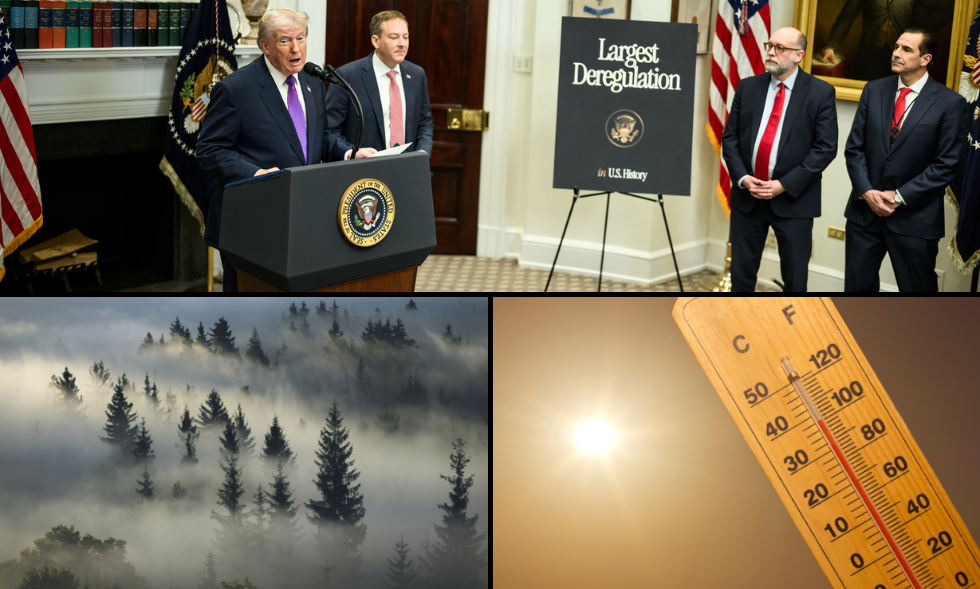
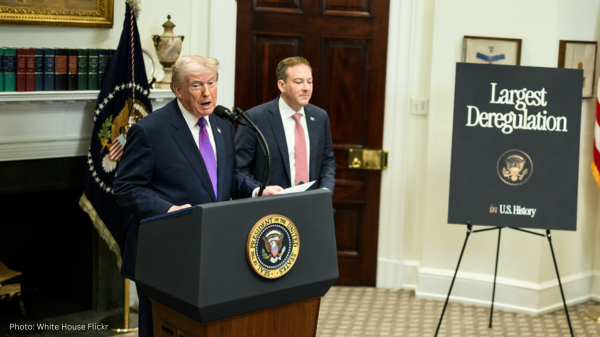
On February 12, 2026, a date that will go down in history for anyone laboring in the climate change arena, President Donald Trump and Environmental Protection Agency (EPA) Director Lee Zeldin took the stage at a press conference to announce the administration was withdrawing the 2009 carbon-dioxide endangerment finding, which was instituted under President Barack Obama.
The endangerment finding established the regulatory framework for the EPA to dictate individuals’ and businesses’ transportation choices in the vain hope of controlling the weather 30 or 70 years from now. The Obama administration did this through regulatory fiat, refusing to respect Congress’s decision on regulation of carbon dioxide, which was that the lawmakers chose not to regulate it. With a later endangerment finding, the EPA granted itself the authority to limit greenhouse gas emissions from power plants as well. The Clean Air Act did not grant this authority.
Those two actions were the largest seizures of regulatory power in U.S. history, granting the EPA virtually unfettered authority to direct economic development. Obamacare, the income tax, endangered species designations, and Social Security were all created through acts of Congress. Not so the endangerment finding. A few politically chosen bureaucrats took the reins of economic power and limited Americans’ choices in cars and trucks, closed power plants and factories, and raised prices for fuel, power, food, plastics, and basically all goods and services. Much of the affordability crisis so many people are complaining about in America can be traced back to the endangerment finding and the economy-constricting rules and regulations it spawned.
“No more,” says Trump.
In a press release, Trump announced the action as …
… the single largest deregulatory action in American history: the full revocation of the disastrous Obama-era “Endangerment Finding” and the consumer mandates that depended on it. This decisive action dismantles the flawed 2009 determination that Democrats weaponized to justify over $1.3 trillion in burdensome regulations on American families, businesses, and consumers.
This historic step clears the path for lower prices, greater consumer choice, and a thriving economy. American families will save an average of over $2,400 on new cars, SUVs, and trucks. Transportation and trucking costs will drop, helping bring down the price of everyday goods. Drivers will no longer be forced into unnecessary, unpopular features that limit choice and jack up costs.
In multiple previous Climate Change Weekly issues, Heartland Institute posts, and official comments, I have explained why the endangerment finding was never justified as a matter of science. There is no climate crisis meriting a government takeover of the economy based on a life-giving gas that humans exhale. The finding was bad as a matter of law because the Clean Air Act does not classify CO2 as a pollutant. And it was bad public policy because it does far more harm to people, the economy, and the environment than any possible benefits it could produce.
Commenting on his agency’s action, Zeldin stated,
With this proposal, the Trump EPA is proposing to end sixteen years of uncertainty for automakers and American consumers. In our work so far, many stakeholders have told me that the Obama and Biden EPAs twisted the law, ignored precedent, and warped science to achieve their preferred ends and stick American families with hundreds of billions of dollars in hidden taxes every single year. We heard loud and clear the concern that EPA’s GHG emissions standards themselves, not carbon dioxide which the Finding never assessed independently, was the real threat to Americans’ livelihoods. If finalized, rescinding the Endangerment Finding and resulting regulations would end $1 trillion or more in hidden taxes on American businesses and families.
Having long called for the endangerment finding’s withdrawal, Heartland researchers were thrilled with the long-overdue action. In a statement, Heartland President James Taylor said,
As a matter of law, the Clean Air Act never countenanced the regulation of CO2. It wasn’t in the letter of the law. CO2 is a naturally occurring gas critical to life on Earth, a non-toxic output of industrial and commercial activities fundamental to the U.S. economy, and a gas emitted every time anyone exhales. If Congress wanted the government to regulate CO2, they should have specifically directed the EPA the ability to do so. Indeed, Congress has debated doing so for decades and has consistently failed to authorize it.
Importantly, as a matter of science, there is no evidence, by which I mean data, that CO2, at any foreseeable level, is a direct threat to human health or welfare. Some claim that CO2 is a threat as an indirect driver of “dangerous” climate change. But those dangerous indirect effects are not in evidence in the real world, but rather only exist in theory and in flawed climate models that have for more than 30 years consistently gotten their basic metric of temperature rise wrong.
While applauding EPA’s action, other Heartland researchers noted that whether one looked at this action as the end of the beginning or the beginning of the end, this was at best an opening salvo in the effort to bring sanity and constitutional order back to U.S. climate and energy policy. Senior Fellow Anthony Watts predicted, rightly, that the battle over the endangerment finding is not over:
The repeal of the EPA’s 2009 Endangerment Finding is a huge step toward restoring climate reality for the United States.
There’s temptation to say, in Star Trek parlance, “It’s dead. Jim.” But, in reality, it is a Yogi Berra moment: “It ain’t over ’til it’s over.” Today’s announcement is poised to trigger a sweeping political, legal, and media backlash.
As the regulatory foundation for nearly two decades of federal climate policy, its reversal will ignite coordinated lawsuits, state-level countermeasures, and an intensified public relations campaign from activist groups and aligned institutions determined to preserve existing climate authorities. Look for courtroom battles, a surge in state-driven climate initiatives, and the likely escalation of extreme-weather attribution claims in the media.
Heartland’s Linnea Lueken said that this was at best a “great first step” and more needs to be done:
This is a great first step towards rolling back all the horribly damaging overregulation that has suffocated American innovation in the last few decades. Rescinding the vehicle emissions related endangerment finding is a necessary and fantastic start. It’s now time to press the advantage.
Undo the damage done by the 2007 Massachusetts v. EPA ruling, remove the powerplant greenhouse gas emissions rules, and make it so that only real legislation passed by Congress would ever put any of it back in place.
Here’s what I said in my press statement:
This action is long overdue and good for the American people, freeing up the auto industry to make the vehicles people want unburdened by unnecessary emission restrictions or money-losing electric vehicle mandates. Today is a win for car and truck buyers, and Trump should be applauded for taking this action.
The endangerment finding was never justified by either science or law. Now it’s time to strike another blow for affordability, and strike while the iron is hot, to rescind endangerment for power plants as well. Let’s hope the Administration is up to the task of defending this decision in court and [ready to] take it all the way to the Supreme Court.
For CO2 regulation to be put back in the hands of the legislature where it belongs, the Supreme Court must overturn the terrible majority ruling in Massachusetts v. EPA, which spawned the endangerment finding in the first place.
Of course, even before the ink was dry on the final rule withdrawing the endangerment finding published in the Federal Register on February 18, climate alarmists rushed to the courthouse door to file suit to overturn the EPA’s action. Knowing the makeup and past rulings of the U.S. District Court in Washington, DC, where this case will be heard, and the past performance of Trump administration attorneys in environment-related cases, the administration will almost certainly lose in the district court. That means a hearing before the U.S. Supreme Court is just about inevitable.
That is both good and bad. An activist Supreme Court ruling treating any and everything emitted into the air as regulable by EPA under the Clean Air Act served as the basis for the endangerment finding. Here’s the good part: in a later, separate case, West Virginia v. EPA, concerning emissions from power plants, the Supreme Court came to a different conclusion, ruling agencies must have an explicit grant from Congress to regulate on major questions involving significant impacts on the economy. The Supreme Court can use that decision as a precedent to overturn Massachusetts v. EPA. The Court should take this opportunity to correct its initial error in expanding the EPA’s Clean Air Act authority beyond the plain language of the law. Whether it will do so is an open question.
While this lawsuit proceeds through the courts, the Trump administration should withdraw the endangerment finding for power plants and other major industrial emitters of carbon dioxide. Protecting cars and trucks from illegitimate EPA overreach should be just the first step in a larger regulatory war.
In the end—and this is the is the bad part, bad not as a matter of law and correct constitutional authority but as a matter of practical politics—Congress should make it clear that neither carbon dioxide nor other greenhouse gases are pollutants that endanger human health or the environment at any foreseeable levels, and as such EPA has no authority to regulate them unless or until Congress determines otherwise. Regulating CO2 is the major question of our time, both in the United States and around the globe. It reaches to the very core of personal freedom, economic progress, and poverty reduction. The problem is, with the current and foreseeable future makeup of Congress and its internal politics, the day when Congress can and will act to retake the responsibility it alone is delegated in the U.S. Constitution is a long time off, barring divine intervention.
That is a sad indictment of the current state of America’s political system.
Sources: The Heartland Institute; Climate Change Weekly; Heartland Public Comments; White House; Associated Press

Warming, CO2 Caused Forest Growth, Carbon Sink Increase
Research published in the journal Biogeosciences shows boreal forests have expanded northward during the recent period of climate change, leading to a substantial uptake in carbon dioxide: as the forests have grown, so has their role as a carbon sink.
An international team of 14 researchers representing universities and research institutes spanning five countries examined a variety of local, national, and international data sets and studies of tree cover distribution, as well as Landsat satellite data at scales of 250 down to 30 meters, to establish a comprehensive picture of boreal forest changes (in this case expansion over decades).
The boreal forest has experienced the fastest warming of any forested biome in recent decades. As they write in the abstract of their study, the researchers found,
From 1985 to 2020, boreal tree cover expanded by 0.844 million km2, a 12 % relative increase since 1985, and shifted northward by 0.29° mean and 0.43° median latitude. Gains were concentrated between 64–68° N and exceeded losses at southern margins, despite stable disturbance rates across most latitudes. Forest age distributions reveal that young stands (up to 36 years) now comprise 15.4 % of forest area and hold 1.1–5.9 Pg of aboveground biomass carbon, with the potential to sequester an additional 2.3–3.8 Pg C [carbon] if allowed to mature. These findings confirm the northward advance of the boreal forest and implicate the future importance of the region’s greening to the global carbon budget.
The Earth’s carbon budget is the made-up or assumed maximum amount of cumulative, net global anthropogenic CO2 emissions that can be released into the atmosphere while limiting global warming to a specific level. If the Earth is absorbing more CO2 than was anticipated or assumed, the amount of CO2 that can be released into the atmosphere without hitting a specified amount of warming (assuming CO2 drives warming) is larger than what is budgeted in climate models.
The expansion and change in age structure of the boreal forest is critical to understanding the carbon budget because “the boreal biome is Earth’s most expansive and ecologically intact forest,” as the study states. “The region contains . . . a total biomass rivaling the tropics and half of global soil C.”
“Its forested area comprises a third of the global total and accounts for 20.8 % of the total forest carbon (C) sink,” the study states. Boreal tree cover also controls the reflective and thermal balance of solar radiation in the high northern latitudes, posing a positive feedback mechanism for greenhouse atmospheric warming.
In short, a larger boreal forest, with a shift toward younger trees with long growth spans, means either more CO2 is being taken out of the atmosphere or will be taken out of the atmosphere than is accounted for by most climate models and theories, and/or more carbon dioxide can be emitted into the atmosphere before reaching temperatures that policymakers want to avoid.
In either case, this research indicates the science isn’t settled on the carbon budget. That means more research is warranted, and government policies should be altered to reflect the new reality. That’s if one believes that human CO2 emissions are causing climate change and that such change is necessarily catastrophic. Based on my reading of the science, I have questions about the first proposition and sincerely doubt the second.
Sources: Phys.org; Biogeosciences

Dutch Meteorological Agency Forced to Acknowledge Earlier Heat Waves
The Royal Netherlands Meteorological Institute (Dutch: Koninklijk Nederlands Meteorologisch Instituut, KNMI) tried to erase the climate history of the Netherlands, claiming recent heat waves were extreme and unprecedented in the past 100 years.
Climate skeptics have disputed this claim for years, noting the KNMI’s assessment gave particular weight to a single site and then homogenized the data in a particular way. That assessment concluded recent temperatures were higher than in previous decades, in part based on unprecedented heat waves. Skeptics argued the KNMI should not analyze just a single sample site to represent past temperatures, but rather the entire array of sites across the country, and should not homogenize the data but rather look at the raw numbers, or at least present the data for a transparent comparison.
The KNMI resisted this effort for seven years, but after years of pressure and a compelling paper published in the journal Theoretical and Applied Climatology (TAC), the KNMI has reassessed the evidence and been forced to acknowledge heat waves similar to those of the present occurred far more often in the past than the KNMI’s adjusted data suggested.
The TAC paper examined five long-term active principal meteorological stations across the Netherlands with temperature records from the beginning of the twentieth century to the present, using a variety of homogenization methods to reconstruct the temperature history across the stations. The paper states,
A total of 116 different variants of the homogenization of De Bilt were carried out, using all combinations of five reference stations, five reference periods, two ways to calculate percentiles, and two ways to smooth the data. The parameters used for the KNMI’s current homogenization of De Bilt result in a very sharp decrease of tropical days, which is not replicated by the majority of the 116 variants. Moreover, after homogenization, De Bilt appears to be an outlier compared to the other meteorological stations. Therefore, the current homogenized estimates of tropical days for De Bilt should be treated with considerable caution.
In lay language, proper homogenization shows the De Bilt station overstated recent warming relative to other stations. It was the outlier.
After years of pressure, the KNMI admitted as much, officially admitting four independent researchers (including Marcel Crok, director of Climate Intelligence, or Clintel) were right: heat waves have been common in the Netherlands across the past century.
The KNMI “reinstated seven ‘lost’ pre-1950 heatwaves at De Bilt—validating claims of over-correction that had erased 16 out of 23 historical extremes,” Clintel posted. “Although KNMI responded in an unprofessional and dismissive manner to our 2019 report, the publication of our critique in a peer-reviewed journal ultimately proved decisive in shifting the debate in our favor.
“In contrast to KNMI’s initial homogenization effort—which was not subjected to formal peer review—our critique underwent rigorous peer review and publication,” Clintel continued. “This strengthened our position in the debate. … So, more than seven years after starting to look into this matter, we were completely vindicated, both by KNMI itself and by the media.”
Although the Netherlands is a relatively small country about the size of Maryland or West Virginia, and its temperatures don’t impact global trends much, this admission represents further evidence that the climate has not been stable for even the past century and official temperature “records” depend as much on who is keeping, managing, and defining the records as they do on the actual recorded data itself. Bad data handlers produce bad temperature reporting.
Sources: Clintel; Theoretical and Applied Climatology